|
Ecological Footprints and Bio-Capacity: William E. Rees, PhD wrees@interchange.ubc.ca Chapter 9 in: Jo Dewulf and Herman Van Langenhove, eds. Renewables-Based Technology: Sustainability Assessment. Chichester, UK: John Wiley and Sons (2006). 9. Ecological Footprints and Bio-Capacity: Essential Elements in Sustainability Assessment 9.1 Introduction It is no small irony that in the age of ‘technological man’ people actually play a greater role in ecosystems than ever. For example, H. sapiens has long been the most successful terrestrial carnivore ever to have walked the earth and, during the 20th Century, humans became the most voracious predator in the world’s oceans. Remarkably, considering our unchallenged status as top carnivore, we are also the dominant herbivore in grasslands and forests all over the planet, particularly if we consider the demands of ‘industrial metabolism’ (Rees 2003a, Fowler and Hobbs 2003). And human impacts transcend biology, earth scientists assert that economic activity has become the most significant geological force altering the face of the planet and climatologists agree that we are now actually beginning to affect global climate. Despite such findings, modern humans—particularly city dwellers—are so psychologically alienated from nature that they rarely think of themselves as animals let alone as dependent components of the world’s ecosystems (Rees 2003b). Indeed, many economists and technological optimists argue that the human enterprise is ‘decoupling’ from the ecosphere. As the late Julian Simon hyperbolically proclaimed, ‘Technology exists now to produce in virtually inexhaustible quantities just about all the products made by nature…’ (Simon, cited in Bartlett 1996, 342). The overall purpose of this chapter, therefore, is to help reground the sustainability debate in biophysical reality. More specifically, I hope to make the case that ecological footprint analysis is a sound basis from which to assess ecological sustainability and to illustrate how the method stimulates questions about sustainable development that are invisible to conventional analyses. 9.2 Eco-Footprint Analysis Despite the cascade of empirical evidence that even the present scale human economic activity threatens to undermine the integrity of the ecosphere, there is little evidence in the international policy arena that mainstream institutions are seriously willing to consider abandoning perpetual growth machine. Indeed, policy makers generally believe that the Malthusian dilemma and concerns about ‘limits to growth’ have long been put to rest (Rees 2002a). According to some authors, ‘Because of increases in knowledge, the earth’s "carrying capacity" has been increasing throughout the decades and centuries and millennia to such an extent that the term "carrying capacity" has by now no useful meaning’ (Simon and Kahn 1984). Growth optimists also insist that, by trading with neighbours, any region or country can eliminate any remaining constraints on growth imposed by limited domestic resource endowments. Ecological footprint analysis (EFA) was introduced explicitly to reopen the debate on human carrying capacity (Rees 1992, 1996; Rees and Wackernagel 1994, Wackernagel and Rees 1996). Indeed, the method gains much of its analytic strength by inverting the standard carrying capacity ratio. If carrying capacity asks ‘how large a population can a particular area support’ (a question that can be rendered seemingly irrelevant by trade) EFA asks ‘how large an area is required to support a particular population’ (a question that includes those areas that are effectively ‘imported’ through trade). Answering this second question enables any population to compare its total biophysical demand on Earth to the biocapacity of its domestic land-base, thus revealing the extent to which that population is living beyond its local ecological means. EFA also allows the population to assess the proposition that its consumption patterns are ‘decoupling’ from nature—i.e., a sequential time series of EFAs will reveal whether the population’s lifestyles are really becoming less material-intensive and more ecological benign. EFA starts from a series of simple premises:
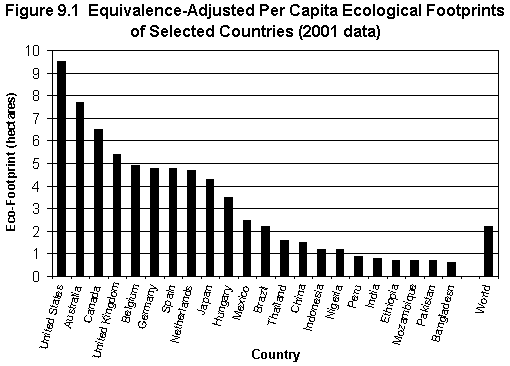
Every human population imposes an ‘ecological footprint’ on Earth equivalent to the amount of the planet’s productive capacity required to supply that population with resources and waste assimilation services. We therefore formally define the ecological footprint of a specified population as the area of land and water ecosystems required on a continuous basis to produce the resources that the population consumes, and to assimilate (some of) the wastes that the population produces, wherever on Earth the relevant land/water may be located (Rees 2001). A complete eco-footprint analysis would thus quantify the total ecosystem area that the population effectively ‘appropriates’ to meet its final demand for economic goods and services, including the area it needs to provide its share of certain (usually free) land- and water-based services of nature such as the carbon sink function. In practice, of course, we cannot consider separately every one of the tens of thousands of consumption items available today. However, most of these are included in major consumption categories such as ‘meat products,’ ‘legumes and pulses,’ ‘plastics,’ ‘organic chemicals’ and like categories that are compiled by national statistical agencies. We are also effectively restricted to those categories of waste such as carbon dioxide and organic nutrients (e.g., nitrates and phosphates) that can readily be represented by an exclusive assimilation area. Indeed, some products such as minerals and concrete are represented in the eco-footprint largely through their carbon sink areas (because of the fossil fuels used to produce them) although relevant mine sites and related degraded landscapes are also included in the analysis. Sometimes we can ignore organic, nutrient or other wastes if it is reasonable to assume that they are being assimilated by land and water areas that are already included in the eco-footprint calculation because said lands produce some relevant commodity (e.g., agricultural products or fish). Still other wastes such as widely dissipated air- and water-borne toxic compounds and ozone depleting chemicals cannot be translated into land area at all. The area of a population’s theoretical eco-footprint depends on four factors: the population size, the average material standard of living, the average productivity of land/water ecosystems, and the efficiency of resource harvesting, processing, and use. Regardless of the relative importance of these factors and how they interact, every population has an ecological footprint and the productive land and water captured by EFA represents much of the ‘natural capital’ (productive natural resource base) required to meet that study population’s consumptive demands. It is important to recognize that population eco-footprints constitute mutually exclusive appropriations of productive capacity. The biocapacity used by one population is not available for use by another. All human populations are competing for the available productive capacity of Earth. Note that ecological footprints can be interpreted in terms of thermodynamic theory (Schneider and Kay 1994). All human activities involve the extraction, consumption, and irreversible dissipation of resources (increasing net entropy). Since contemporary production of renewables is driven by solar energy, a population’s true ecological footprint represents the area required continuously to generate photosynthetically a quantity of biomass energy and material (negentropy) equivalent to the amount used and dissipated by the population’s consumptive activities. 9.2.1 Basic Methods Population eco-footprints are based on final demand for goods and services. Thus, the first step in calculating the ecological footprint of a study population is to estimate the total annualized consumption of significant categories of commodities and consumer goods consumed by that population. Data are obtained from national production and trade statistics and other sources such as various United Nations statistical publications. For accuracy, consumption data should be trade-corrected. Thus the population’s consumption of pulses (beans, peas and lentils) can be represented as follows: The second step is to convert consumption of each item into the land/water area required to produce that item (or to assimilate the wastes generated in its production) by dividing total consumption by world average land productivity or yield for that item. This step gives us the ecological footprints of the individual consumption categories. In the case of non-organic items such as metals, we use the land sterilized for mines, tailings and smelters as well carbon dioxide output —from the fossil energy used in production—to estimate that component’s eco-footprint (see reference to carbon dioxide emissions below). Built-up and damaged lands (usually urban-related) are measured directly. The third step estimates the total ecological footprint of the population by summing the footprints for the individual consumption/waste categories. Finally, we can obtain the per capita ecological footprint of the study population obtained by dividing the total population footprint by population size. For some wastes such as carbon dioxide emissions, or nutrients such as phosphates and nitrates, it is also possible to calculate the exclusive land/aquatic ecosystem area required for sustainable assimilation and recycling. (Carbon sinks constitute most of the eco-footprint area associated with fossil fuels themselves as well as that for many energy intensive non-organic products.) In all such cases, the assimilation rate per hectare and year is substituted for yield in the calculations described above. For basic population ecological footprints (e.g., for whole regions or countries) EFA assessors usually use world average yields/assimilation rates in each major land categories (cropland, pasture, forest land, productive marine area, etc.). This simplifies calculations since we not have to trace all the sources of trade goods and waste sinks nor determine the productivity and assimilative capacities of the corresponding production/assimilation areas. In all cases, we strive to avoid overlap and double-counting. For example, we would not need to estimate the grazing land eco-footprint associated with leather goods because animal hides are usually a by-product of the meat and dairy industry whose contributions are already included. To facilitate comparisons among countries and to estimate national ecological surpluses or deficits, analysts further adjust the basic footprint calculations to a common scale. For example, if country ‘A’ uses a great deal of relatively unproductive pasture land per capita compared to another country, ‘B’, that uses more highly productive cropland, then country ‘A’s eco-footprint will seem disproportionately (unfairly) large compared to country ‘B’s. To provide a more balanced comparison, we make an ‘equivalence adjustment’ by converting each land-type component of the basic national eco-footprints into its equivalent area in terms of ‘global hectares’ where a global hectare is a standardized hectare (ha) of world average productivity (see WWF 2002). Thus, if country ‘A’ uses the equivalent of two ha of average pasture per capita, and average pasture is half as productive as a standard global hectare, then the representation of pasture in country ‘A’s eco-footprint is scaled down to only one global hectare per capita (2 ha ´ .5equiv). One of the most interesting and useful applications of nation-level EFA is in the assessment of each country’s ecological surplus/deficit. Here we ask the following questions: What part of a country’s net consumption could be accommodated by that country’s domestic biocapacity? Could this country be more or less self-sufficient if necessary? We answer these questions by subtracting each country’s ecological footprint (based on global hectares) from the area of its domestic productive land-base (also converted to equivalent global hectares by factoring in domestic yields). A positive answer implies that the subject country’s consumption imposes a load on Earth less than the its total domestic biocapacity—i.e., the country has an ecological surplus. If the answer is negative, then the country’s ecological load exceeds its domestic bio-capacity. In this case, the relevant population is living, in part, on apparent surplus biocapacity imported from other countries or from the global commons. (For fuller details of methods see WWF 2002). 9.2.2 The Eco-Footprints of Nations: Measuring Relative Sustainability Figure 1 displays the equivalence-adjusted eco-footprints of a selection of the world’s nations (based on 2001 data compiled in WWF 2004). As might be expected, per capita eco-footprints are positively correlated with income. The residents of the United States, Australia, Canada, many Western European and other high-income countries each require from five to 10 hectares (12-25 acres) of productive land/water to support their consumer lifestyles. By contrast, the citizens of the world’s poorest countries have average eco-footprints as low as half a hectare (ha). Even burgeoning China’s per capita eco-footprint in 2001 was less than two hectares. The average human ecological footprint is about 2.2 ha. - Figure 1 near here - Consider these demand data in light of global supply and prospects for sustainability. In 2001, there were only about 9.9 billion ha of productive cropland, pasture, and forest on Earth and fewer than two billion ha of equivalent fishable shallow ocean, for a total of about 11.3 billion ha, and over 6.1 billion people. In short, there were only 1.8 ha of productive ecosystem per capita on the entire planet. With an estimated average eco-footprint of 2.2 ha per capita, the human population already had a total eco-footprint of almost 13.5 billion ha. This means that by a fairly conservative estimate, humanity had already ‘overshot’ the long-term human carrying capacity of the Earth by about 20% in 1999—the whole planet is in deficit. (A population can live in overshoot—i.e., beyond its ecological means—for a considerable period by depleting vital ecosystems and non-renewable resource stocks.) These aggregate eco-footprint data imply that to bring just the present world population up to, say, North American material standards with prevailing technology would require four additional Earth-like planets! (Figure 2). This should pose a serious conundrum for those who insist on sustainability through material growth—it has been noted that ‘good planets are hard to find.’ - Figure 2 near here - The situation is more complex from the sustainability perspective than is suggested by gross overshoot alone. Many high-density high-income countries have eco-footprints several-fold larger than their domestic territories. These countries are running large ‘ecological deficits’ with the rest of the world. The Netherlands, for example, requires almost six times its domestic biocapacity to sustain prevailing levels of net consumption. (Figure 3, Table 1). - Figure 3 and Table 1 near here - As noted above, citizens of such deficit countries live, in part, on life support services imported from other countries and by imposing a disproportionate load on the global commons. Indeed, wealthy market economies like those of the US, Canada, most Western European countries and Japan appropriate two to five times their equitable share of the planet’s productive land/water (and 20 times or more per capita than the chronically impoverished). By contrast, low-income countries like Bangladesh, Mozambique and even China, use only a fraction of their equitable population-based allocation. The growing income disparity between rich and poor is dramatically reflected in the corresponding eco-footprint data. (Note that the prevailing forces of globalization tend to exacerbate rather than level these gross eco-economic inequities.) Eco-footprinting thus reveals the hidden role of global trade. The enormous purchasing power of the world’s richest nations enables them to finance their ecological deficits by extending their ecological footprints deeply into exporting nations and throughout the open ecosphere (Rees 2002b). Wealthy and powerful nations can now achieve through global commerce what used to require territorial occupation. The obvious ecological problem is that not all countries can run a biophysical deficit—for every sustainable deficit there must be a permanent surplus somewhere else. Unfortunately, the apparent ‘surpluses’ of the few large ‘under-populated’ countries such as Australia and Canada (Figure 3, Table 1) have already been absorbed into the eco-deficits of other countries. This is why, in net terms, there is no global surplus (remember that 20% global overshoot?). 9.3 Inherent Strengths in EFA 9.3.1 The Scientific Merit of EFA Ecological footprint analysis has gained considerable momentum around the world as both heuristic device and practical method for assessing sustainability. This success derives in part from methodological strengths of EFA that are both scientifically well founded and reflect thinking people’s intuitive sense of reality. On the technical/scientific side, EFA has several qualities that reinforce its credibility as a sustainability indicator. The method:
9.3.2 Popular Acceptance of EFA People are intelligent beings capable of responding rationally to new knowledge particularly if it can be shown to be directly relevant to their own circumstances. For this reason, the eco-footprint concept resonates better with the public than do more abstract and impersonal sustainability indicators. In particular, people appreciate the way EFA draws them into reflecting on their personal consumption habits as illustrated by the popularity of EFA-oriented web-sites that offer simple calculators that visitors can use to estimate their personal eco-footprints. Attributes of EFA that help to communicate biophysical reality to the public include the following:
9.4 Answering the Critics Ecological footprint analysis is not a perfect tool and the method has attracted its fair share of criticism from both academics and practitioners. Some criticisms stem from real weaknesses of the method or from misunderstandings of its scope and potential. Others, however seem more to reflect the critic’s discomfort with the findings and implications of EFA than they do flaws in the method. The following selection of criticisms are draw both from the published literature (e.g., several articles in Ecological Economics 32 (2000), pp. 341-394), from papers that the author has reviewed on behalf of various journals, and from colleagues’ direct questions and challenges. The critique can be partitioned into two broad categories—concerns about methods or the concept itself, and concerns about the policy relevance. 9.4.1 Conceptual and methodological critiques EFA raises questions of human carrying capacity: We do, in fact, use EFA to compare economic production/consumption to available biocapacity (carrying capacity) as a sustainability test. However, various critics, particularly economists, continue to object that in today’s world human carrying capacity is irrelevant and that a nation’s domestic bioproductivity should in no way constrain its growth, influence its development policy or affect its citizens lifestyle choices. This view reflects the view that individual trading regions are open systems that can effectively import ‘carrying capacity’ from elsewhere. Unfortunately, this argument fails on the macro scale—the earth as a whole is materially closed. It is simply not possible for all countries to be simultaneous net importers of biocapacity. EFA has an anti-trade bias. It assumes eco-deficits are bad and reduces sustainability to self-sufficiency: EFA shows that many rich countries and urban regions have enormous ecological footprints. Cities typically ecologically occupy an area several hundred times larger than their geographic areas and many whole countries draw on the biophysical capacity of an ecosystem area several times their productive domestic land base (Folke et al. 1997, Rees 2003b). However, these facts do not in themselves express an anti-trade or anti-urban bias. They merely underscore the biophysical dependence of densely populated, high consuming regions/countries on other countries and the global commons and remind us that such regions appropriate more than their fair share of global biocapacity (Wackernagel and Silverstein 2000). In fact, the data show that self-sufficiency actually lies beyond the realistic reach of regions/countries with large eco-deficits. Some trade is not only a good thing but is absolutely necessary for sustainability in these situations. All the same, we live an era of accelerating global ecological change and uncertain geopolitics. This suggests that there may be an optimal level of trade-reliance and that perhaps greater regional self-reliance might be a good thing. (Does near total dependence on extra-territorial resources in a rapidly changing world enhance or erode a nation’s security?) Many people also question a global economic system that enables the already rich to buy sustainability out from under the struggling poor. Such reasoning is apparently alarming to neo-liberal economists and other expansionists who favour unrestrained growth facilitated by trade. By stimulating discussion of carrying capacity, optimal trade levels and relative dependence/self sufficiency, EFA implicitly challenges the core developmental economic ideology of our time. This does not weaken EFA but may undermine prevailing ideology. EFA ignores technology and the substitutability of manufactured for natural capital. It therefore supports growth pessimists: Some critics argue that EFA ‘seems not to be in accordance with mainstream ecological economics that assumes at least some substitution between different types of capital.’ Others allege that EFA assumes ‘…technology will not be able to overcome biophysical limits.’ These assertions are erroneous because eco-footprint analysis per se makes no assumptions whatever about material substitutions or technological change. Most population EFAs typically represent real-time snapshots of de facto energy and material flows at the time of the analysis, whatever the prevailing level of technological sophistication. They represent what is, not what should be or what could be. EFA analysis is fully responsive to technological changes or substitutions that might significantly affect a population’s eco-footprint. (Keep in mind, some innovations and substitutions actually increase the eco-footprint) (Rees 2003a). It is worth noting that the claim ‘EFA supports growth pessimists’ is actually not a criticism but rather a conclusion. As such, it may reveal a hidden fear of growth optimists that perhaps there is a weakness in their own paradigm. On representing energy consumption: Some critics are uncomfortable with the large contribution energy makes to typical eco-footprints—about half the global average eco-footprint, and a greater proportion in high-income countries (Table 1). Others dispute the use of terrestrial carbon sequestration as the measure of society’s use of fossil fuel on several grounds, e.g., a carbon sink is not a ‘real’ land use; carbon sequestration faces real economic constraints (‘society will never accept the high costs of terrestrial-based CO2 strategies’); or that renewable energy would generate a smaller eco-footprint. Much of this criticism, comes from either a misunderstanding of how EFA treats energy or from discomfort generated by having to confront humanity’s large energy eco-footprint. First, the fact that energy consumption looms large in EFA simply represents reality. Energy is absolutely vital to industrial society as the means by which we do everything else. Energy-use creates a large EF primarily because of thermodynamic laws, not because of methodological flaws in EFA. As for using carbon sink area to represent fossil fuel use, let’s remember first that EFA is an ecosystem-based way of assessing consumption and that ecosystems store carbon in biomass; second, that modern society consumes increasing amounts of fossil energy, releasing huge quantities of carbon dioxide into the atmosphere and thus into the biologically active carbon pool. Indeed, carbon dioxide waste is a major factor in atmospheric change and a primary ‘forcing mechanism’ for climate modification. A consensus has therefore emerged that, for sustainability, large quantities of this greenhouse gas must be sequestered. The terrestrial ecosystem area that would be required to assimilate industrial CO2 emissions—less the amount routinely taken up by the sea—is therefore a legitimate representation of society’s fossil-fuel energy footprint. (Certainly, too, dedicated carbon-sink forests are very real land use.) Some critics argue that we could reduce the energy eco-footprint if it were based on some form of renewable energy alternative such as biomass fuels. This approach would indeed produce a different eco-footprint and when the use of alternative energy begins to have a serious impact on carbon emissions, any positive result will show up in subsequent EFA studies. Note, however, that techno-optimists may be disappointed by efforts to substitute for fossil fuels. For example, thermodynamic law dictates that the biomass equivalent of fossil fuels would generate a larger eco-footprint than the carbon sequestering method and would create other problems. For example, more fossil energy is used to produce a litre of ethanol than is contained in the ethanol so that the relevant energy footprint would have to comprise both the original carbon sink area plus the corn-growing area. The latter is substantial. To grow sufficient maize to provide the ethanol equivalent of just one third of US automotive fuel would require as much cropland as is needed to feed the entire US population (Pimentel 2003). Putting all this together, EFA simply recognizes that carbon emissions are a real contemporary problem, that we have not developed artificial carbon dumps or adequate alternative fuels, that the principle way nature stores carbon in the short term is in biomass (indeed, that this is the only way substantial quantities of carbon are currently being sequestered) and that it is possible for humans to establish at least some dedicated carbon sink forests. In short, the large energy footprint due to excessive carbon dioxide emissions is not a fault of EFA (which is merely the bearer of the bad news) but of over-consumption relative to available biocapacity. In this sense, the large contemporary energy eco-footprint is actually a robust finding of the EFA method. EFA assumes that ‘land’ is being used sustainably: This charge is true and bothersome. Much land and many critical ecosystems are being degraded. Part of the reason we do not account for the unsustainable use of nature is the sheer labour intensity of determining erosion and depletion rates of areas in question. The question does arise, however, of how would one use the data were they available? Suppose soil degradation were 30 times the rate of renewal (probably close to the world average). If we inflated the arable land component of the eco-footprint reflect such information per capita eco-footprints would be numbingly large—would anyone take them seriously? As matters stand, the estimated average EFs, unadjusted for land degradation, show everything needed for a reasoned policy response in the right direction without being intimidating or discouraging. 9.4.2 EFA and Sustainability Policy EFA offers no policy guidance: Economists in particular reject EFA on grounds that the method is a simplistic static tool that ‘provides little use in directing policy,’ is ‘inadequate for policy design’ or ‘does not assist in the analysis of sustainability.’ It is true that the EF is a single numerical index so that, in isolation, it can hardly suggest policy directions (the same can be said of GDP/capita). However, the notion that EFA is irrelevant to policy would come as a surprise to the hundreds of government agencies, academics, citizen organizations, NGOs, policy advisors, etc., around the world who are using EFA precisely to identify, highlight or address numerous policy issues pertaining to sustainability. As this chapter reveals, EFA is powerfully indicative of policy choices for countries that have excessive eco-footprints, including greater regional self-reliance, conserving natural capital, developing dedicated carbon sink forests, investing in alternative energy, working toward greater global equity, etc. Significantly, many of the policy issues and options raised by EF studies (e.g., bio-capacity, the risks of excess trade dependence, ecological deficits, self-reliance, etc.) remain invisible to conventional analysis. Indeed, it is more than a little ironic that economists would reject EFA on grounds that it has little to offer to sustainability policy. Unlike EFA, economists’ policy models are totally abstracted from biophysical reality. Indeed, according to economist James K. Galbraith they no longer even describe economic reality. The major problem is ‘…the nearly complete collapse of the prevailing economic theory…. It is a collapse so complete, so pervasive, that the profession can only deny it by refusing to discuss theoretical questions in the first place’ (Galbraith 2000, italics added for emphasis). So much for policy relevance. What about socio-economic factors? Some critics reject the use of EFA in policy analysis because it ‘devoid of any socio-economic factors.’ On one level, this is a straw-man partial truth, and to that extent it is irrelevant. The very term, ‘ecological footprint analysis’ declares that the method is intended to generate a human ecological index, not a social indicator. There is no logical reason why an ecological index should incorporate social factors per se. That said, it remains instructive on socio-economic grounds to compare to the size and composition of per capita eco-footprints at opposite ends of the income distribution (Figure 1). The relatively wealthy 25% of the world’s population with the largest eco-footprints are responsible for 86% of personal consumption. This bloated share of consumption appropriates virtually all the biophysical capacity of the planet in important categories. Such data show that efforts to relieve poverty and achieve sustainability through material economic growth are futile, an uncomfortable proposition for any expansionist to contemplate. Typical EFA studies lack predictive power: This seeming ‘criticism’ is true but irrelevant. Many useful indices are based on static analyses. For example, average ‘life-expectancy’ is not a predictive indicator but it is a good measure of population health; the ‘human development index’ is not a predictive tool but it is accepted as a good aggregate indicator of, well, relative ‘human development’; ‘GDP’ is not a predictive tool but it is generally regarded as a fair indicator of aggregate economic activity (but, to be sure, it is a poor indicator of human welfare). One might criticize a dynamic model that fails to make good predictions but it is silly to reject static models and indicators (contemporary ‘snapshots’) on the same grounds. In any event, analysts could use EFA in simulation studies involving assumed life-style changes or advances in technology and thus predict the likely effect on ecological demand. EFA results are depressing: To quote one critic, ‘[EFA] is becoming a global aggregated indicator of ecological overshoot and doom.’ As shown in a previous section, EFA suggests that the world economy is, in fact, in a state of overshoot in that the estimated total global eco-footprint is somewhat larger than the aggregate eco-productive area of the planet. This conclusion is supported by myriad empirical data on everything from the collapse of fish stocks through accelerating landscape/soil degradation to the accumulation of greenhouse gases. If this suggests ‘doom’ to our critics it may once again reflect their own subjective fears that the findings may actually be accurate. On the positive side, having a tool that recognizes the danger enables EF analysts to recommend the policies, strategies and behavioural changes required to address the situation precisely to avoid ecosystemic collapse and related forms of ‘doom.’ 9.5 Summary This paper argues that ecological footprint analysis provides a robust method for assessing ecological sustainability. EFA is firmly rooted in human ecological reality and clearly reflects the most basic of biophysical laws. The logic of the method flows from the simple fact that the scale of human economic activity must fit within the productive capacity of the ecosphere. In this light, it is encouraging that the ‘footprint’ metaphor seems to have captured the public imagination. Because EFA personalizes the sustainability crisis—everyone is a consumer and has an eco-footprint—the human eco-footprint has become one of the most effective and best known indicators of global (un)sustainability. Most importantly, by focusing on physical resource stocks and flows, and on quantifiable real-world ecosystems capacity, EFA stimulates questions about sustainability that are invisible to conventional economic assessments. In particular, EFA has succeeded in putting the questions of local and global carrying capacity back on the policy table. Hardly any sustainability analyst is not now aware of the ‘overshoot’ phenomenon as highlighted by EFA. The finding that to raise just the present world population to North American material standards sustainably would require several addition Earth-like planets is frequently cited in the sustainability literature and in public debates around the world. EFA certainly remains an imperfect tool. However, its major weakness may be the inherent conservatism of the method rather than the concerns expressed by economists and techno-optimists. EFA findings, already alarming enough, likely under-estimate rather than over-estimate the total human load. In this light the real sustainability problem is that the official world remains in the thrall of the perpetual growth myth.
Literature Cited Bartlett, Albert. 1996. The Exponential Function XI: The New Flat Earth Society. The Physics Teacher 34: 342-343. Carley, M. and P. Spapens. 1998. Sharing the World: Sustainable Living and Global Equity in the 21st Century. Earthscan Publications, London. Catton, W. R. 1980. Overshoot: The Ecological Basis of Revolutionary Change. University of Illinois Press, Urbana and Chicago. Daly, H. 1991. The Circular Flow of Exchange Value and the Linear Throughput of Matter-Energy: A Case of Misplaced Concreteness, in H. E. Daly, Steady-State Economics (2nd ed.) Island Press, Washington. Ecological Economics 32 (2000), pp. 341-394, ‘Forum on the Ecological Footprint’ Ehrlich, P. and J. Holdren. 1971. Impact of population growth. Science 171:1212-1217. Folke, C., A. Jansson, J. Larsson, and R. Costanza. 1997. Ecosystem appropriation by cities. Ambio 26: 167-172. Fowler, CW and Hobbs L. 2003. Is humanity sustainable? Proceedings of the Royal Society of London, Series B: Biological Sciences 270: 2579-2583. Galbraith, J.K. 2000. How the Economists Got it Wrong. The American Prospect 11, no. 7 (February 14). Georgescu-Roegen, N. 1971. The Entropy Law and the Economic Process. Harvard University Press, Cambridge, MS. Hall, C. (ed.) 1995. Maximum Power: The Ideas and Applications of H.T. Odum. University Press of Colorado, Niwot, Colorado. Pimentel, D. 2003. Ethanol Fuels: Energy Balance, Economics and Environmental Impacts are Negative. Natural Resources Research 12 (2): 127-134. Rees, W. E. 1992. Ecological footprints and appropriated carrying capacity: what urban economics leaves out. Environment and Urbanization 4 (2): 120-130. Rees, W. E. 2001. Ecological Footprint, Concept of. Encyclopedia of Biodiversity (Simon Levin, Editor-in-Chief). Vol 2, pp 229 –244. Academic Press, San Diego. Rees, W.E. 1996. Revisiting carrying capacity: Area-based indicators of sustainability. Population and Environment 17: 195-215. Rees, W.E. 1999. Consuming the Earth: The Biophysics of Sustainability.’ Ecological Economics 29: 23-27. Rees, W.E. 2002a. Carrying Capacity and Sustainability: Waking Malthus’ Ghost, in David V.J. Bell, and Y. Annie Cheung, (eds). Theme: ‘Introduction to Sustainable Development.’ Encyclopedia of Life Support Systems (EOLSS). Eolss Publishers, Oxford, UK. [http://www.eolss.net] Rees, W.E. 2002b. Globalization and Sustainability: Conflict or Convergence. Bulletin of Science, Technology and Society 22 (4): 249-268 Rees, W.E. 2003a. Net-pen salmon farming: failing on two fronts—an eco-footprint analysis. Pages 139-152 in P. Gallaugher and L. Wood, Editors. Proceedings of the World Summit on Salmon. Simon Fraser University, Burnaby, B.C., Canada. Rees, W.E. 2003b. Understanding Urban Ecosystems: An Ecological Economics Perspective, in Alan Berkowitz et al.eds., Understanding Urban Ecosystems. Springer-Verlag, New York. Rees, W.E. and M. Wackernagel. 1994. Ecological Footprints and Appropriated Carrying Capacity: Measuring the Natural Capital Requirements of the Human Economy. Chapter 20 in A-M. Jansson, M. Hammer, C. Folke, and R. Costanza (eds), Investing in Natural Capital: The Ecological Economics Approach to Sustainability. Island Press, Washington, DC Schneider, E. and J. Kay. 1994. Life as a manifestation of the second law of thermodynamics. Mathematical and Computer Modeling 19:6-8:25-48. Simon, J. and H. Kahn (eds). 1984. Introduction to The Resourceful Earth: A Response to ‘Global 2000.’ Basil Blackwell, Oxford. Wackernagel, M. and W.E. Rees. 1996. Our Ecological Footprint: Reducing Human Impact on the Earth. New Society Publishers, Gabriola Island, BC and Philadelphia, PA. Wackernagel, M. and J. Silverstein. 2000. Big things first: Focusing of the scale imperative with the ecological footprint. Ecological Economics 32: 391-394. WWF. 2004. Living Planet Report 2004. Worldwide Fund For Nature International, Gland, Switzerland.
Figure 9.2 Phantom Orbs—to sustain today’s 6.2 billion global villagers at North American levels of energy and material consumption would require four additional Earth-like planets.
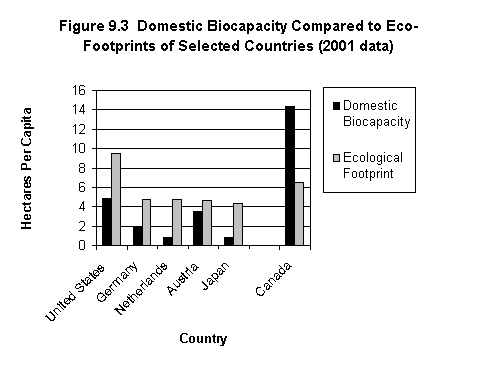
Table 9.1: Overshoot—The Ecological Deficits of a Selection of the World’s Most Advanced Economies
 Your comment or question Your comment or question
|

 to
to  halt
halt  | ecostory | feedback
 ecoglobe
  since1997
9205