CO2 Emissionen,
BSP pro Person, BSP pro Person und pro Stunde.
CO2 Emissionen pro BSP und pro Person.
|

| |
Heute werden für jede einelne der mehr als 6,5 Milliarden ErdenbewohnerInnen pro Jahr mehr als 7 Tonnen CO2 in die Luft ausgestossen. Als Folge unserer Aktivitäten ist der Gehalt dieses Treibhausgases in der Atmosphäre um beinahe 30 Prozent gestiegen.
|
|
Wir meinen, dass die Berechnung von CO2-Ausstössen pro Land keinen Sinn macht weil die Produkte die wir verbrauchen überall auf dem Planeten hergestellt werden. Unser persönliches Kosumbudget ist deswegen wohl die beste Abschätzung unserer Umweltbelastung und unseres persönlichen Anteils an den Treibhausgasemissionen.
(Emissionszertifikate)
The world GDP (Gross Domestic Product) is approximately 44 500 000 millions of US Dollars per year. Carbon emissions are 24 000 million tons or 24 000 000 million kilograms per year. Thus, one US Dollar GDP represents 0,54 kilograms of CO2.
So, if your personal budget is 50 000 US Dollars per year, you are responsible for 27 000 kilograms or 27 tons of CO2 emissions per year.
 So what? - How does this relate to individual country emissions accounts? So what? - How does this relate to individual country emissions accounts?
World carbon emissions are 24.000 million tons per year. Individual countries' emissions are:
USA
EU
Japan
China
GDP of the European Union 13,446,050 millions of US Dollars (30 %) =
GDP of the United States 12,485,725 millions of US Dollars (28 %).
Carbon Credits
A Carbon Credit is a certificate that certifies the right to emit a certain amount of carbon dioxide. Carbon Credits are issued by a country or by a group of countries, e.g. the EU. The authorities set the amount of Carbon Credits available to an industry sector. A company that emits less CO2 than the amount set by the aurhorites can sell its surplus on a Carbon Credit market. Companies who emit too much CO2 can must buy Carbon Credits. They can also offset their surplus emissions by investing in waht are deemed t0 be relatively carbon-neutral projects in developing countries.
The environmental NGOs have from start been critical of this scheme, as can be seen from the below "Carbon
Credit" bill that was distributed at the Kyoto conference of The Hague in 2000.
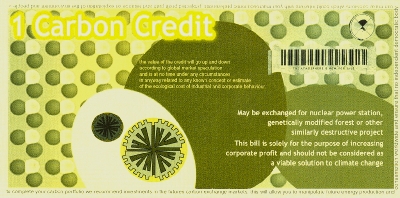
It reads:
1 Carbon Credit
"the value of the credit will go up and down
according to global market speculation
and is at no time under any circumstances
in any way related to any known concept or estimate
of the ecological cost of industrial and corporate behaviour."
The small print along the edges reads:
"to complete your carbon portfolio we recommend investment in futures carbon exchange markets. this will allow you to
manipulate future energy production and consumption and ensure that no independent democratic body can make decisions
which could interfere with your macroeconomic preferences, projected profit path and reliance on exploitation of the
environment and people >
|
We don't believe that carbon trading will help the environment in any way. In fact we argue that the Kyoto Protocol itself it a waste of time and effort, which should be spent on direct measure to reduce our impact on the environment, that is reducing the scale and the speed of our economic activities as well as relocalising economic structures. Compare Useless Kyoto.
Climate change
Votre opinion -
Ihre Meinung
|
 ecoglobe since 1997